Business Innovation in Retail; Design driven innovation in traditional grocery department store.

Updated: Feb 2, 2019

Redefining the business innovation driven omni channel customer experience in retail industry. Design process is user centric, to design and evaluate insights, comparing the current & emerging trends and in the end render the ideas to exhibit.
Project timeline
Business innovation class' project
Teacher:- Emilio Bellini, Federico Artusi and Giuseppe Pinto
Business design knowledge/tool provided by
LEADIN’Lab, LEadership DEsign and INnovation Lab- Retail Service Innovation Area
Business Innovation in retail experience at Scuola del Design - Politecnico di Milano, Italy.
Team members
Alazne Irastorza : Product Design engineering
Edoardo Giacchini : Product Design
Federico Paparella : Product Design
Ilaria Odoli : Product and interior Design
Manex Bilbao : Product Design engineering
Nerea Dorronsoro : Product Design
Project Detail
The international competitiveness has increased in the past years and companies are forced to constantly innovate to survive and compete in a more and more globalised world. Few times in history had the ability to disrupt the grocery business model in such fast and all-encompassing ways that the necessity to develop a new service in this retail has become an actual need.
Following the guidelines of the next image we developed our own innovation of meaning. First the existent solution was analysed to have some insights to come up then with the existent meaning, having an overall view of the business strategy that nowadays is used by most of the grocery stores. Then, a new meaning was found and implemented with a solution that emerged from it.
To do all this, it was necessary to comprehend some terms and expressions such as innovation or “meaning”. Moreover, several templates were used to synthesise all the information that was gathered during this phase.
All the process was produced considering the design aspect (user needs), function aspect (technology), and the form/aesthetics aspect (experience), that is, using a design driven innovation approach.


After having an overview of the historical and socio-cultural contexts, a retail safari was done
visiting four relevant shops of the sector. Here, we analysed the actual solutions that companies
use and found some signs and clues in physical and digital touchpoint, that is, some insights, that
we interpreted to obtain the existing meaning of grocery stores. To make this job easier, the Retail
Safari app was used by the group, allowing to write and post significant pictures.
Idea development stage
Having defined witch the new meaning and solution are, we started the development of the new service. For this the most effective tools were used, to describe the costumer’s experience (infinite customer journey, storyboard), the aesthetics of the shop (moodboard), the new business model (business model canvas).
Personas
In order to direct the design of the new service, the most relevant users were taken into account and described using personas. These relevant people are the following ones: a student that makes shopping weekly and not in big quantities, a mother with little kids that makes shopping once in two weeks for all the family members, an old lady that makes shopping routinely but feels exhausted by the weight that this means and a business man that limited time to do the shopping. These users were described specifically describing personal characteristics, motivations, frustrations and other aspects.

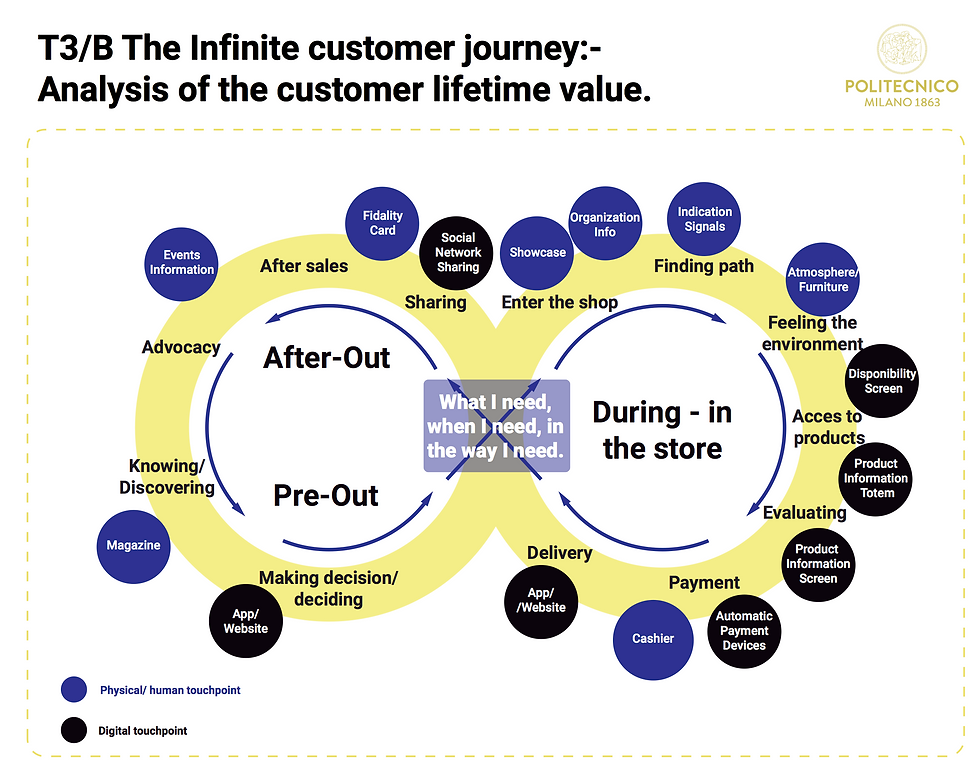
The Infinite customer journey:- Analysis of the customer lifetime value.
1. We are providing the waiting area with full of nature, warm and spotlighting and customer journey mapping is helping us to understand the effectiveness of this intervention.
2. Ordering from totems is a second main intervention in our idea and this is allowing our customer to think of making an order in a different way in the case of traditional grocery stores, which could be a most selling point for us. But to make sure the effectiveness of this intervention we have started this mapping a customer journey.
3. Our meaning is; My spending time is valuable", which means that the store is aware of the value of the customer’s time. So giving a customised experience to each one of the customers is really important, that's why customer journey map is a most effective tool for to us understand the customer behaviour.

Omni-channel customer journey
In the omni channel model create a seamless integration of all of them allowing him to move freely from channel to channel. Accommodating different customers behaviours allowing them more options to reach the same end point. An example using the digital influence to promote some in-store purchases or blending a digital experience -like the one you have when you order- with a physical one –like the one you have while you’re waiting in the lounge room.

Service blue print
The customer can place an order trough one of the interactive totems in the store. For any kind of troubles there are some employers ready to explain and help during the order phase. Once the order is placed the costumer wait to receive it's bags. In the meanwhile he can take something from the in store cafe or have a look on the screens in the waiting area. He can learn more on what he usually buy or can explore for new ingredients and new recipes. Moreover he can watch cooking or housekeeping tutorials. Once the order is ready to be picked the costumer goes to desk with the receipt's number and collects the shopping bags.

Moment of truth
This moment is based on a relaxing time, you wait at a comfortable space, where you sit in front of a screen that tells you how to achieve your shopping goal. Also makes you suggestions of how to use in an optimal way your products and which exclusive ones you can achieve, because of the reason that you are at the shop and there are just customised and selected for you. In this way you value the sensation of familiarity.
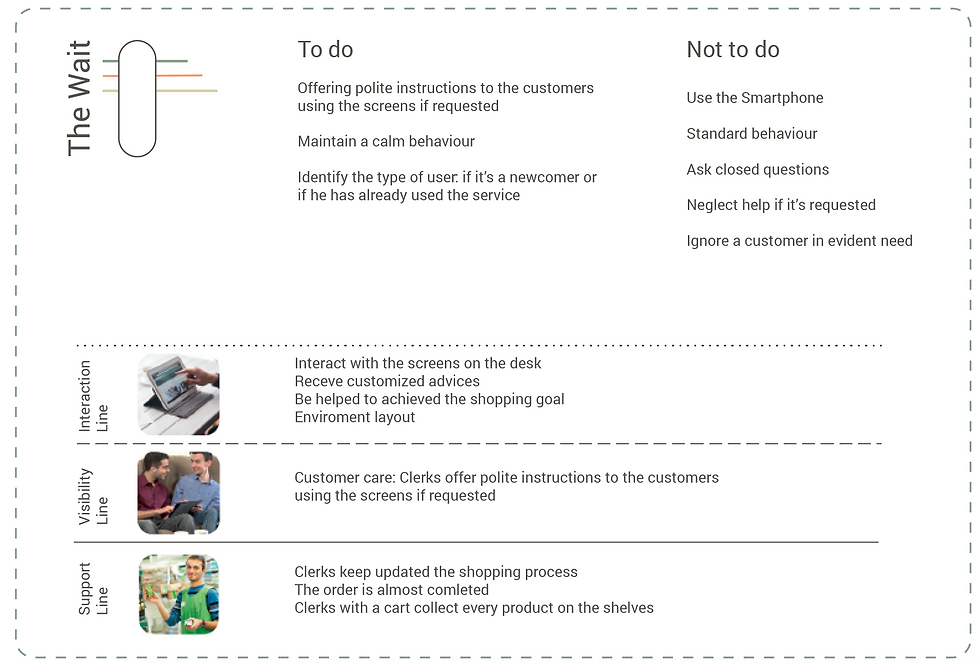
Redesign the retail experience, updated business model canvas and customer experience journey map


Comments